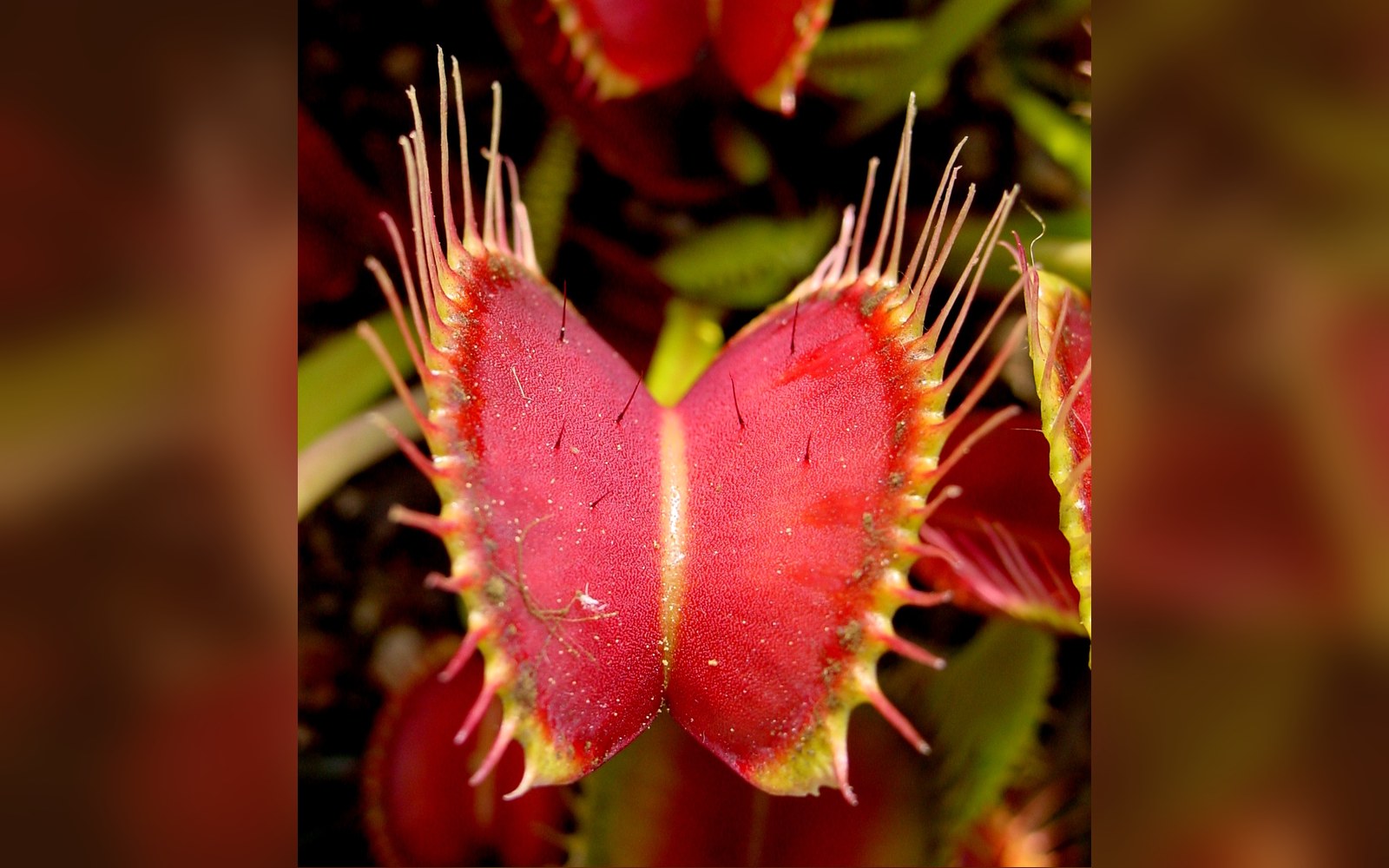
The Venus flytrap grows wild within roughly ninety miles of Wilmington, North Carolina, and in no other place on earth. The range is not a generalization — it is a biological fact with a hard edge.
The mechanics are familiar even to people who have never seen the plant in the wild: two lobed leaves hinged at a midrib, fringed with interlocking teeth, armed on their inner surfaces with three trigger hairs per lobe. An insect touches one hair, nothing happens. It touches a second — or touches the same hair twice within about twenty seconds — and the lobes snap shut in roughly a tenth of a second, one of the faster movements in the plant kingdom. The teeth mesh into a cage before the prey can escape. Digestive glands then flood the sealed chamber with enzymes, and over the course of five to twelve days the soft parts of the insect are dissolved and absorbed. The trap reopens, desiccated exoskeleton still inside, and can function again.
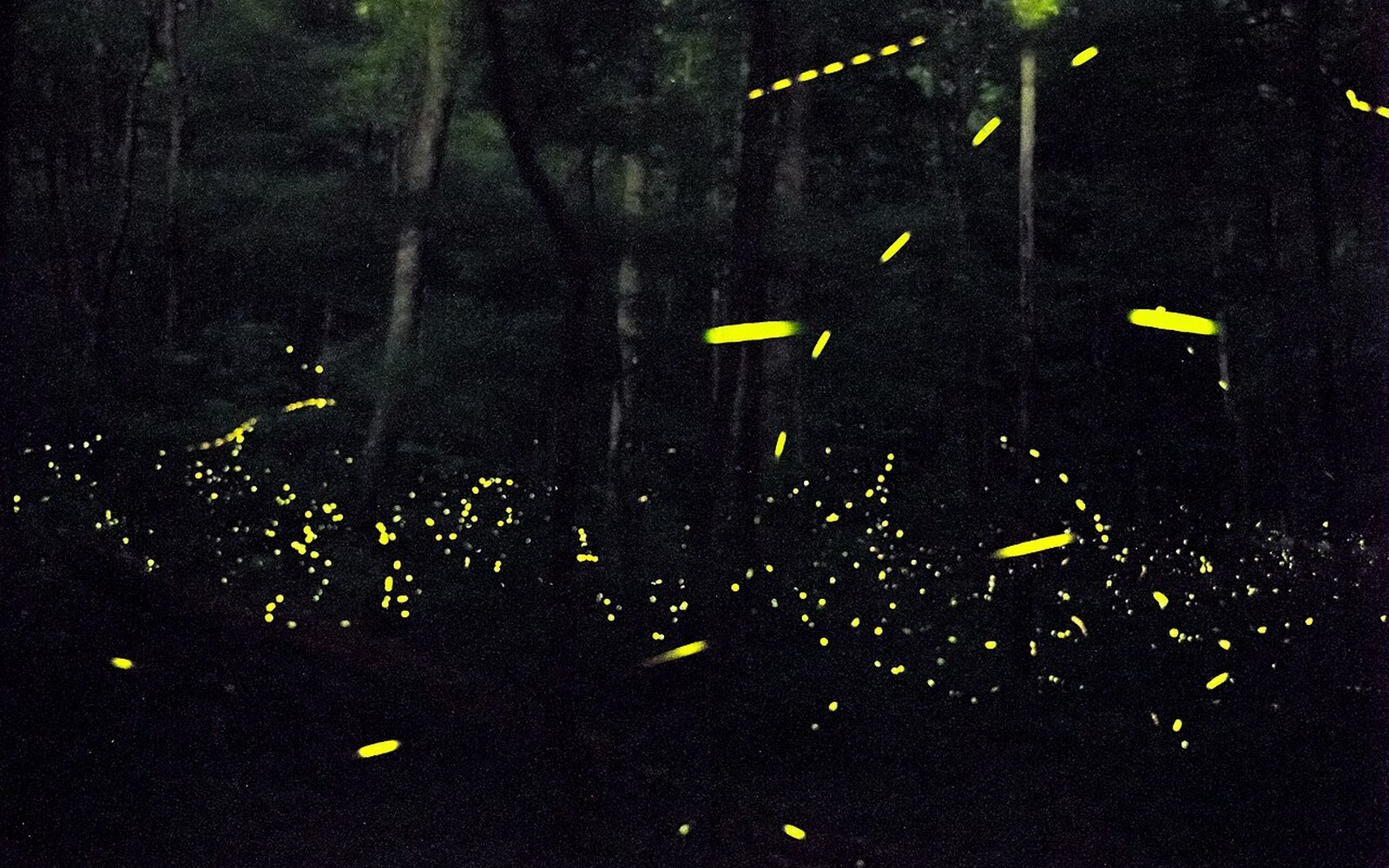
Photinus carolinus synchronises across a hillside for a short window each summer, and the parks now ballot access because of it.
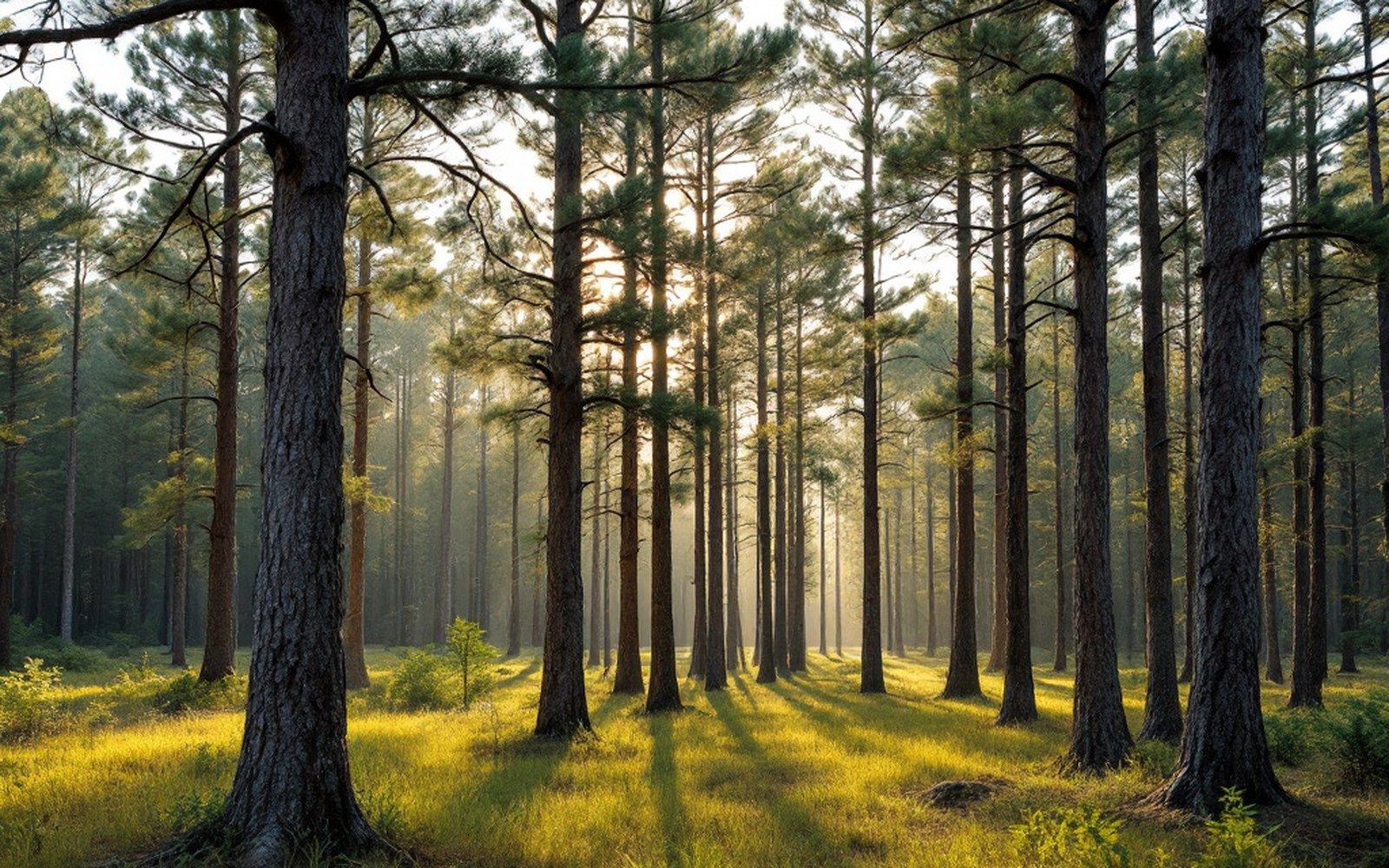
Read the piecePhoto: Photinus carolinus Great Smoky Mountains · Wikimedia CommonsThe trap's purpose is nutritional, not predatory in any animal sense. Dionaea muscipula lives in longleaf pine savannas and pocosin margins — wet, fire-maintained, nutrient-starved soils where the usual underground partnerships between roots and soil microbes cannot supply nitrogen in useful quantities. The plant compensates: it gets its nitrogen from what it catches. Remove the fire regime that keeps the canopy open and the competing vegetation down, and the flytrap is shaded out within years. It is not, in other words, merely a curiosity living somewhere inconvenient. It is the product of a very specific set of conditions that the coastal plain of the Carolinas happens to produce: acid, sandy, seasonally waterlogged soil, low in nutrients, regularly burned.
The question that has occupied botanists since the plant was first formally described is why the range is so tight. Dionaea muscipula was named by John Ellis, a British naturalist, in 1768, based on specimens and observations relayed by North Carolina colonial governor Arthur Dobbs, who had encountered it in the Cape Fear River basin. Other carnivorous plants — sundews, pitcher plants, bladderworts — appear on multiple continents. The flytrap is native only to Brunswick, Columbus, Bladen, Pender, Onslow, and a handful of neighboring counties in North Carolina, with a small population historically documented just across the South Carolina state line. The ninety-mile radius around Wilmington is not a loose approximation: the plant simply does not occur outside it, and populations found elsewhere are introduced rather than native.
Longleaf pine savanna was once the dominant ecosystem of the southeastern coastal plain, covering perhaps ninety million acres from Virginia to Texas before European settlement. Centuries of fire suppression, turpentine harvesting, timber cutting, and conversion to agriculture and development reduced that to roughly three percent of the original extent. The Venus flytrap lost most of its habitat along with it. What remains in North Carolina exists in fragments — some protected within North Carolina State Parks and the Green Swamp preserve, some on private land, some in places that are formally protected but have been too long without fire to support healthy populations.
The Green Swamp, a Nature Conservancy preserve in Brunswick County, holds one of the largest intact remnants of longleaf pine savanna in the state and is among the most important flytrap sites in the world. The plant occurs there in the ground layer beneath open pine canopy, often beside Sarracenia pitcher plants and several species of sundew — all working the same nutrient-extraction strategy in different mechanical forms, all dependent on the same disturbance regime. Prescribed fire is not incidental management at sites like this; it is the primary tool. Without it, the shrub layer closes, the pine canopy fills, and the ground-layer flora collapses.
The soil chemistry reinforces the picture. These are Ultisols and Entisols, leached by rainfall over long periods until they hold almost no phosphorus or nitrogen in plant-available forms. The pH is low — often between 3.5 and 5.5. The water table is close to the surface for much of the year. Most vascular plants cannot thrive under these conditions. The Venus flytrap can, because it has outsourced its nitrogen budget to its prey.
The wild flytrap population is much smaller than it was even fifty years ago. Habitat loss accounts for most of that decline, but collection has compounded it steadily. Dionaea muscipula has been commercially propagated for decades and can be grown readily from tissue culture — a greenhouse-grown flytrap is cheap and widely available. That has not stopped the removal of wild plants, which carry a cachet, real or imagined, among collectors and which can be dug by the thousands in a single night's work.
North Carolina made the unlawful taking of Venus flytraps a felony in 2014. The law targets commercial-scale poaching specifically: taking more than a defined threshold of plants from land without the owner's consent is a Class H felony, punishable by up to twenty-five months in state prison. Several prosecutions have followed. In 2019 and subsequent years, law enforcement operations in Brunswick and Columbus counties resulted in convictions for felony poaching, with defendants having taken hundreds to thousands of plants from protected and private lands.
The North Carolina Plant Protection and Conservation Act also lists the Venus flytrap as a protected plant, restricting any taking without a permit. Together, the felony statute and the plant protection listing represent an unusually strong legal framework for a single species. Enforcement depends on wardens patrolling large areas of coastal plain at night, on tip lines, and — increasingly — on the difficulty of selling hot plants into a market that is aware of the prosecution record.
The flytrap is also listed under the Convention on International Trade in Endangered Species (CITES) Appendix II, which requires export permits and documentation. Wild-collected plants moving across international borders are theoretically traceable. In practice, the volume of legal, propagated plants in global trade makes laundering easier, and the pressure on wild populations has not stopped.
A plant that evolved a digestive system to cope with its soil is telling you something specific about that soil, that climate, that fire history. The Venus flytrap is not a novelty — it is a signal. The coastal plain around Wilmington produced a set of conditions severe enough, and long-lasting enough, that a flowering plant solved the nitrogen problem by becoming a predator. That solution only works in one place on earth, which is why the plant only lives in one place on earth, and why losing that place — to development, to fire suppression, to the person with a trowel and a plastic bag — loses something that cannot be reconstructed anywhere else.