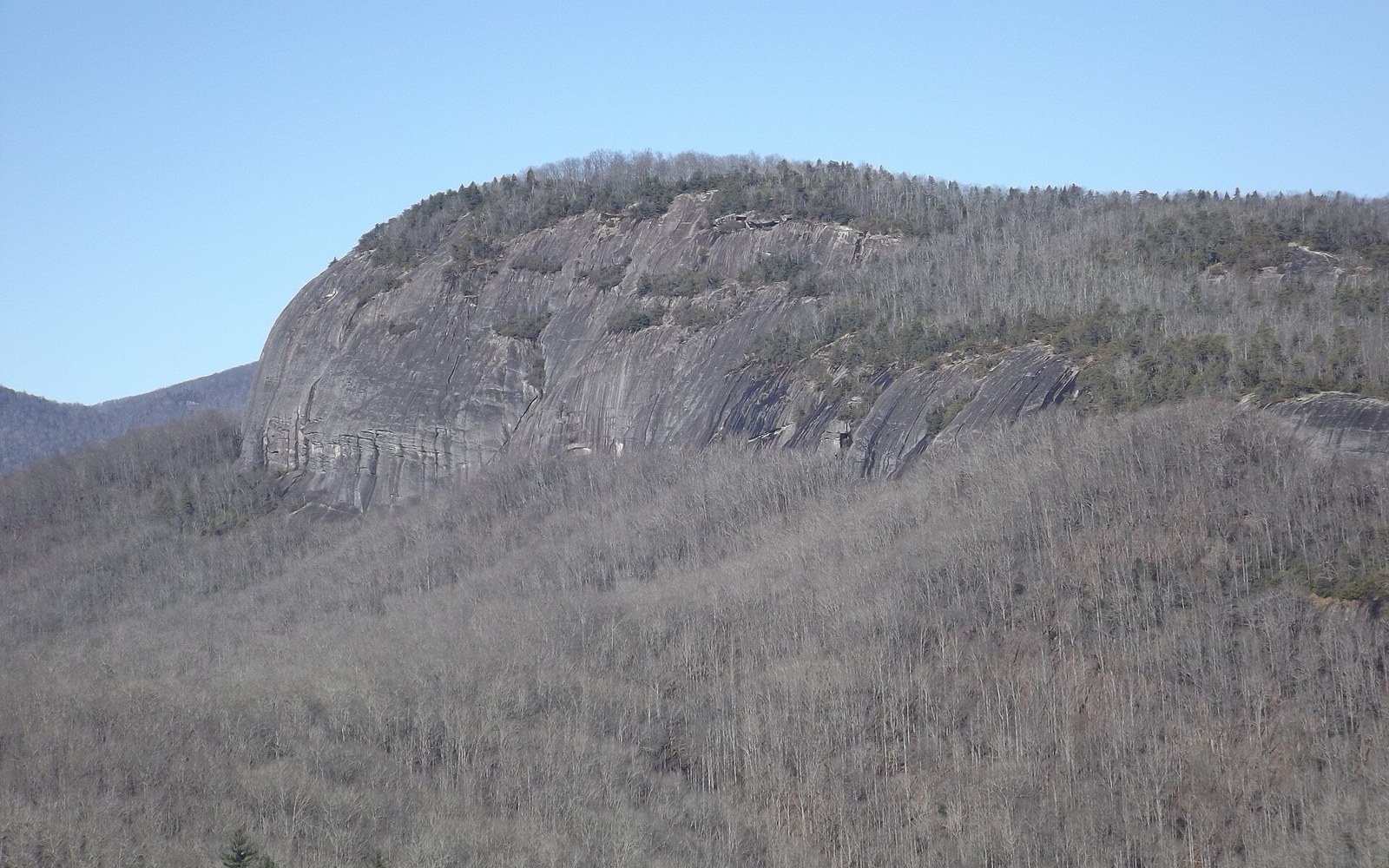
The north face of Looking Glass Rock glazes with ice each winter — and has been drawing climbers to its granite for decades.
Looking Glass Rock rises from the Pisgah National Forest in Transylvania County, a dome of coarse Appalachian granite that summits at roughly 3,969 feet above sea level, according to U.S. Geological Survey records. The name comes from winter. When melt water seeps through the rock and refreezes on the bare north face, the resulting ice sheet catches the low-angle light and throws it back across the forest below like a mirror — a looking glass. The effect is fleeting, gone once temperatures rise, but vivid enough that it named the place permanently.
The rock itself is exposed plutonic granite, forced upward as magma during ancient orogenic events and then stripped of its cover over hundreds of millions of years of erosion. What remains is a curved exfoliation dome — a shape produced as pressure releases from the unroofed rock, causing outer sheets to peel away in a process called sheeting or spalling. The result is a largely unbroken face several hundred feet high, steep enough on its north side to hold ice, bare enough everywhere to hold very little else.
Because the face is silica-rich and nutrient-poor, the summit supports an unusual scrub community — stunted oaks, mountain laurel and Table Mountain pine clinging to shallow pockets of soil in cracks and ledges. The Pisgah National Forest surrounds and protects the formation, and the forest itself has been a working landscape since Gifford Pinchot and George Vanderbilt's Biltmore Estate forestry operations in the 1890s laid the groundwork for what became one of the first tracts in the eastern national forest system.
Climbers began documenting routes on the north face in earnest in the 1970s. The face offers crack systems, slabs and face climbs across a wide range of difficulty, and it has developed a reputation as one of the more significant granite climbing destinations in the southern Appalachians. Conditions dictate access: the same ice that named the rock draws climbers who tackle it frozen, and makes a spectacle of it for everyone else.
From the Blue Ridge Parkway to the east, the dome reads simply as a gray shoulder of forest. Knowing what it is — a pressure-released exfoliation dome that ices like glass, keeps its own scrub community and draws people up a bare face in rubber shoes — makes the shoulder a different thing to look at.