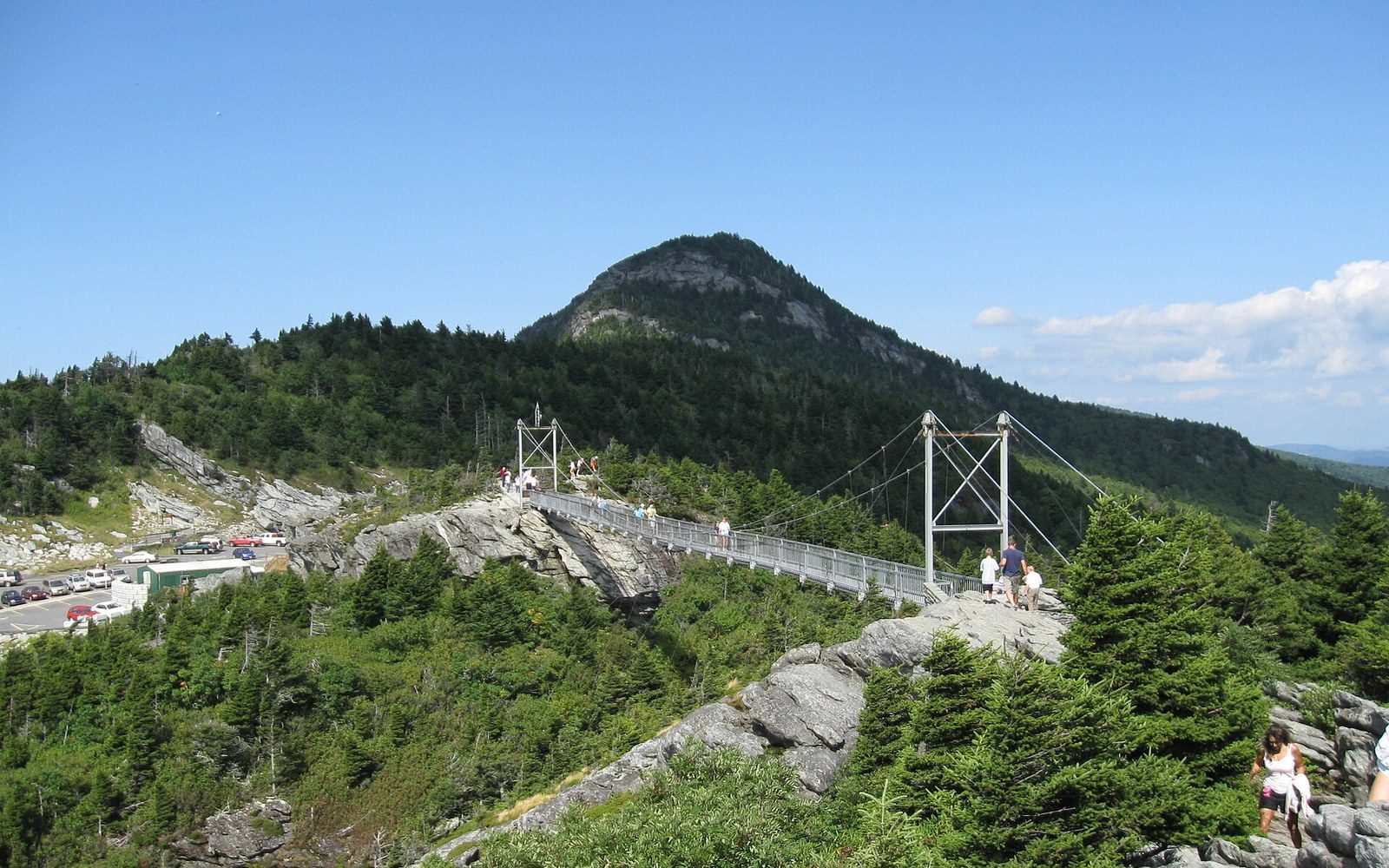
The swinging bridge at Grandfather Mountain crosses a gap between peaks standing on billion-year-old rock. Both facts are worth the drive.
The Appalachians are old — ancient, by any ordinary measure — but Grandfather Mountain carries something older still beneath its ridgeline. The exposed rocks on its upper flanks include the Grandfather Mountain Window, a geological formation where erosion has cut through the overthrust sheets of later rock to reveal basement material dating to roughly 1.1 billion years, among the oldest surface exposures in the entire Appalachian chain. The ocean floor that eventually closed to form the proto-Atlantic had not yet opened when this rock was new. The continents that would eventually drift, collide and push up the modern Appalachians were not yet configured.
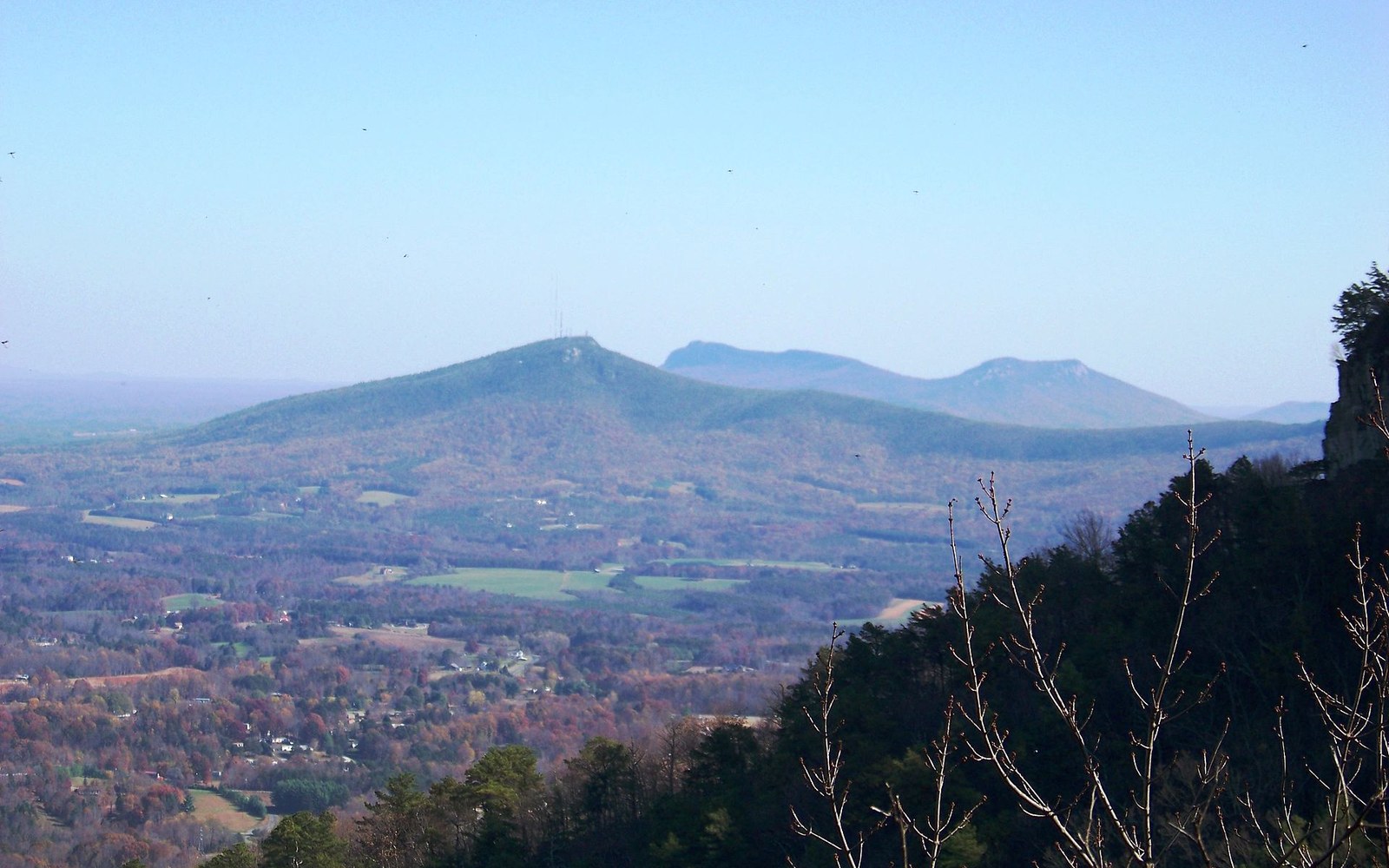
A monadnock is the hard core of a landscape whose softer country eroded away around it. Pilot Mountain and Hanging Rock are quartzite that simply refused to leave.
Read the piecePhoto: Sauratown Mountain from Pilot Mountain (North Carolina) - panoramio · Wikimedia CommonsThese are metamorphic and metasedimentary rocks — quartzite, phyllite and metaarkose — deformed by heat and pressure over geological time, then re-exposed by hundreds of millions of years of erosion. The formation is formally known as the Grandfather Mountain Formation, a Proterozoic sequence that geologists recognize as stratigraphically distinct from the surrounding Blue Ridge. It is one of the clearest windows anywhere in the eastern United States into the crust as it existed before complex animal life.
What the driver on the Blue Ridge Parkway sees is rougher, knobblier, more weather-wracked than anything else on that stretch of ridge. The reason is partly lithological — these rock types resist differently than the granite gneisses dominating the range to the south — and partly structural. Grandfather stands proud of the surrounding ridgeline because the geology underneath it resisted the same long smoothing-down that flattened much of the surrounding landscape. It is not, strictly, a monadnock — the resistant-remnant type of isolated summit whose classic form is Pilot Mountain to the east — but the underlying logic, hard rock outlasting its neighbors, applies.
The mountain's place in Appalachian history is partly about elevation. In the 1850s, Thomas Clingman, a congressman and later a Confederate general, argued that the peak now bearing his name — Clingmans Dome, on the Tennessee-North Carolina border — outranked Mount Mitchell. Elisha Mitchell, the University of North Carolina professor who had made the first serious barometric surveys of the Black Mountains in the 1830s, returned to re-measure and settle the matter. Mitchell died in 1857, falling into a waterfall while descending alone, before the argument was fully resolved. Grandfather Mountain played its own small role in the regional surveying tradition: it was a prominent, visible peak from much of the western Piedmont, a fixed point that surveyors and naturalists oriented by, long before the height rankings were settled.
André Michaux, the French botanist who traversed the Southern Appalachians in 1794, climbed what he believed to be the highest peak in North America and sang the Marseillaise on the summit. Subsequent measurement showed he had climbed Grandfather Mountain, not the highest summit in the chain — off by a significant margin — but the moment stands as an emblem of how imperfectly the range was understood at the time.
The Mile High Swinging Bridge was constructed in 1952 and links two rocky outcroppings near Grandfather's 5,946-foot summit, according to elevations recorded by the United States Geological Survey. At that elevation — close enough to a mile to earn the name — the bridge spans a gap above a sheer drop on both sides, and it moves. The engineering is intentional: a suspension footbridge rated for wind load, the deck swaying perceptibly in the updrafts that funnel through the gap in almost any weather. The cables are fixed; the movement is the design.
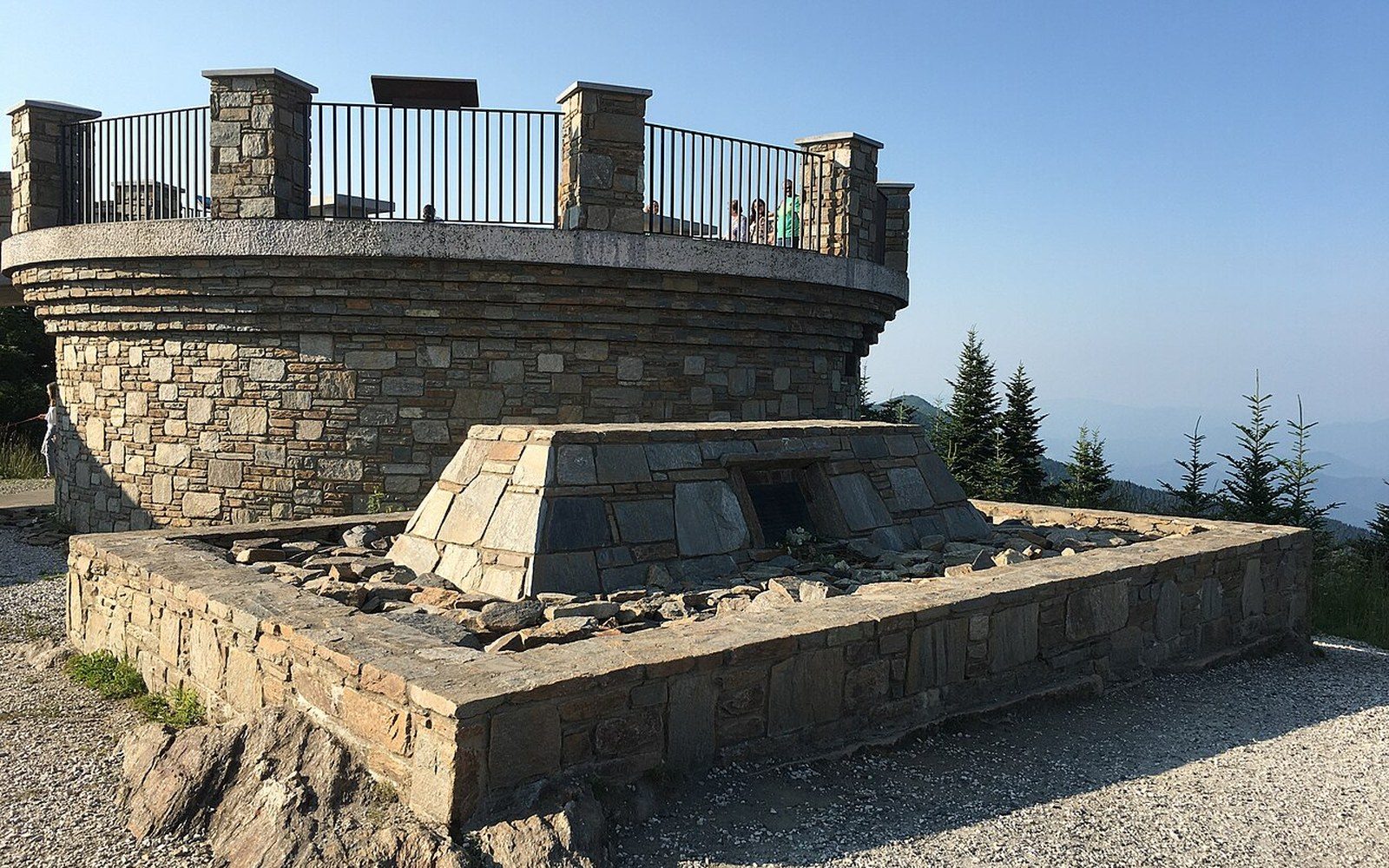
Looking south from the bridge on a clear day, the Blue Ridge Escarpment is visible as a structural break in the landscape, where the mountains drop sharply toward the Piedmont. Looking north and west, the main crest of the Appalachians fades into Virginia and Tennessee. Below the bridge, the same ancient quartzites that line the upper faces extend down through the boulder fields and into the coves, carrying the same billion-year story at every level. The bridge sways, and the rock holds, as it has held longer than almost anything else that can be named.