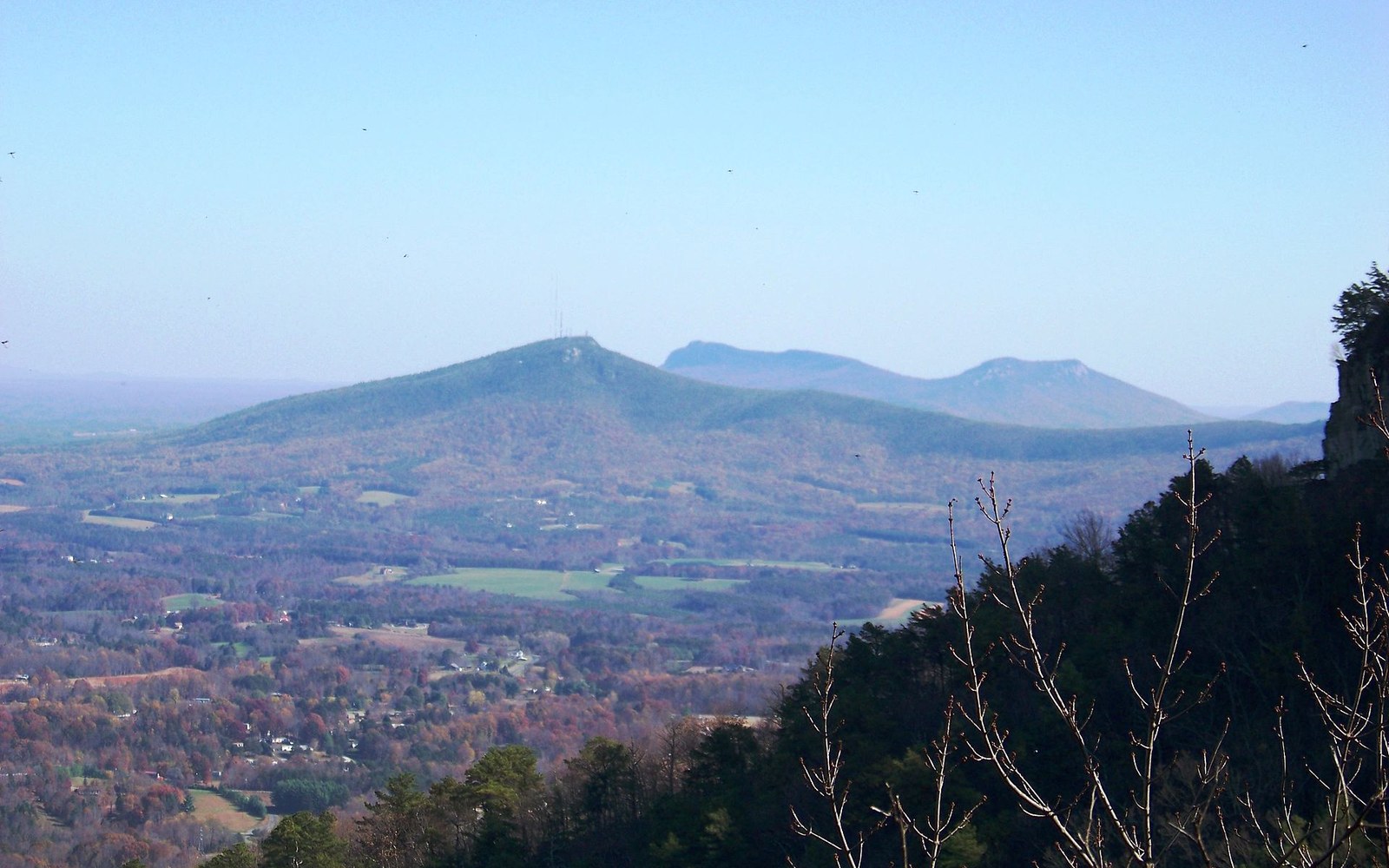
The quartzite was always there. The Blue Ridge foothills simply eroded away from around it.
The instinct, standing at the base of Pilot Mountain and craning up at the knob, is to think of something pushed upward — a plug of resistant rock forced through softer country, the way a thumb breaks through clay. The geology runs exactly the other direction. Pilot Mountain and its neighbor to the east, Hanging Rock, are monadnocks: isolated residual hills that survive because the rock composing them was simply too hard to wear away at the rate the surrounding landscape eroded. Everything around them came down. They stayed. What looks like elevation is, in the most literal sense, what time could not subtract.
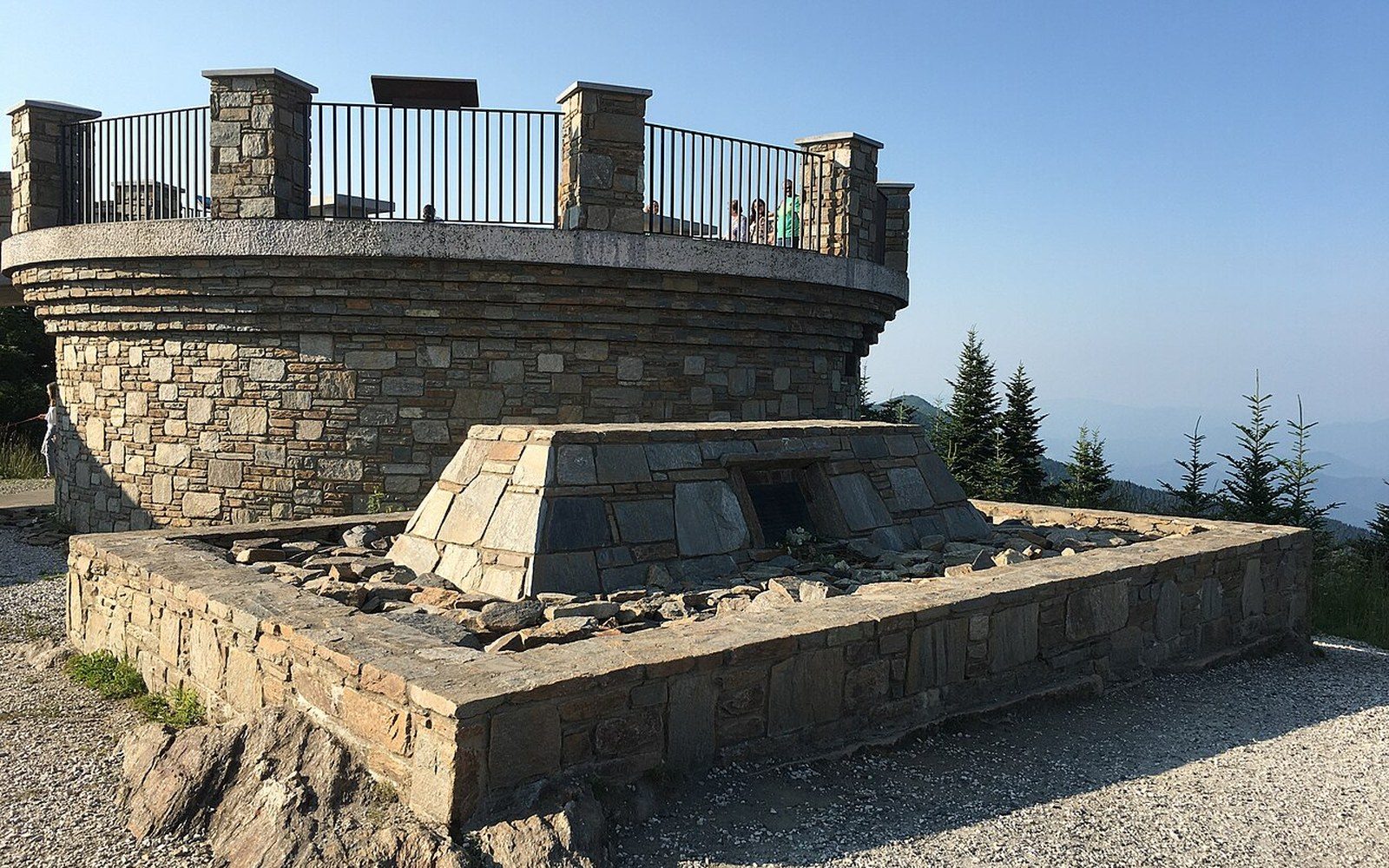
The term monadnock entered geology through a New Hampshire peak of the same name, which the geographer William Morris Davis used in the late nineteenth century to describe any such isolated remnant standing above a peneplain — a landscape reduced nearly to a flat surface by prolonged erosion. The southern Appalachian foothills are not a classic peneplain, but the principle holds: where rock is uniform in resistance, the land grinds more or less evenly down. Where a vein of unusually hard material runs through, the land grinds down around it and the hard stuff persists.
At Pilot Mountain, that hard stuff is quartzite — a metamorphic rock formed when sandstone is heated and compressed until its silica grains fuse into an interlocking mass with almost no weak planes for water and ice to exploit. Quartzite resists both chemical and mechanical weathering with unusual stubbornness. The surrounding Sauratown Mountains, themselves a small isolated range detached from the main Blue Ridge, are also quartzite-cored, which is why the whole cluster — Pilot, Hanging Rock, Moore's Knob — stands above the Piedmont at all. They are not a range that built up; they are a range that failed to fall.
Pilot Mountain's profile is distinctive enough that it served as a landmark for everyone who moved through the Piedmont: the Saura people who gave the surrounding hills their name, the long hunters working south and west before any survey had fixed the country, and later the surveyors themselves. The Saura called it Jomeokee, a word generally translated as "great guide" or "pilot," which European settlers then rendered more literally. It appears on colonial-era maps under variations of its current name, useful in an age of dead reckoning as a fixed point visible from many miles.
What makes the summit knob so visually striking — that rounded, nearly vertical-sided cap sitting atop the broader lower slopes — is the result of differential erosion at the contact between rock types, and the effect of jointing patterns within the quartzite itself. The rock is fractured in roughly vertical planes, so the cliff face tends to break away in great slabs rather than crumbling. The top of the knob, roughly 200 feet of sheer cliff rising above the Little Pinnacle and the saddle below it, is essentially quartzite that has simply shed its loose material down-slope while the core remained. The elevation measured by the National Geodetic Survey places the summit at 2,421 feet — not high by Appalachian standards, but impressive for its isolation and its abruptness above the Piedmont floor.
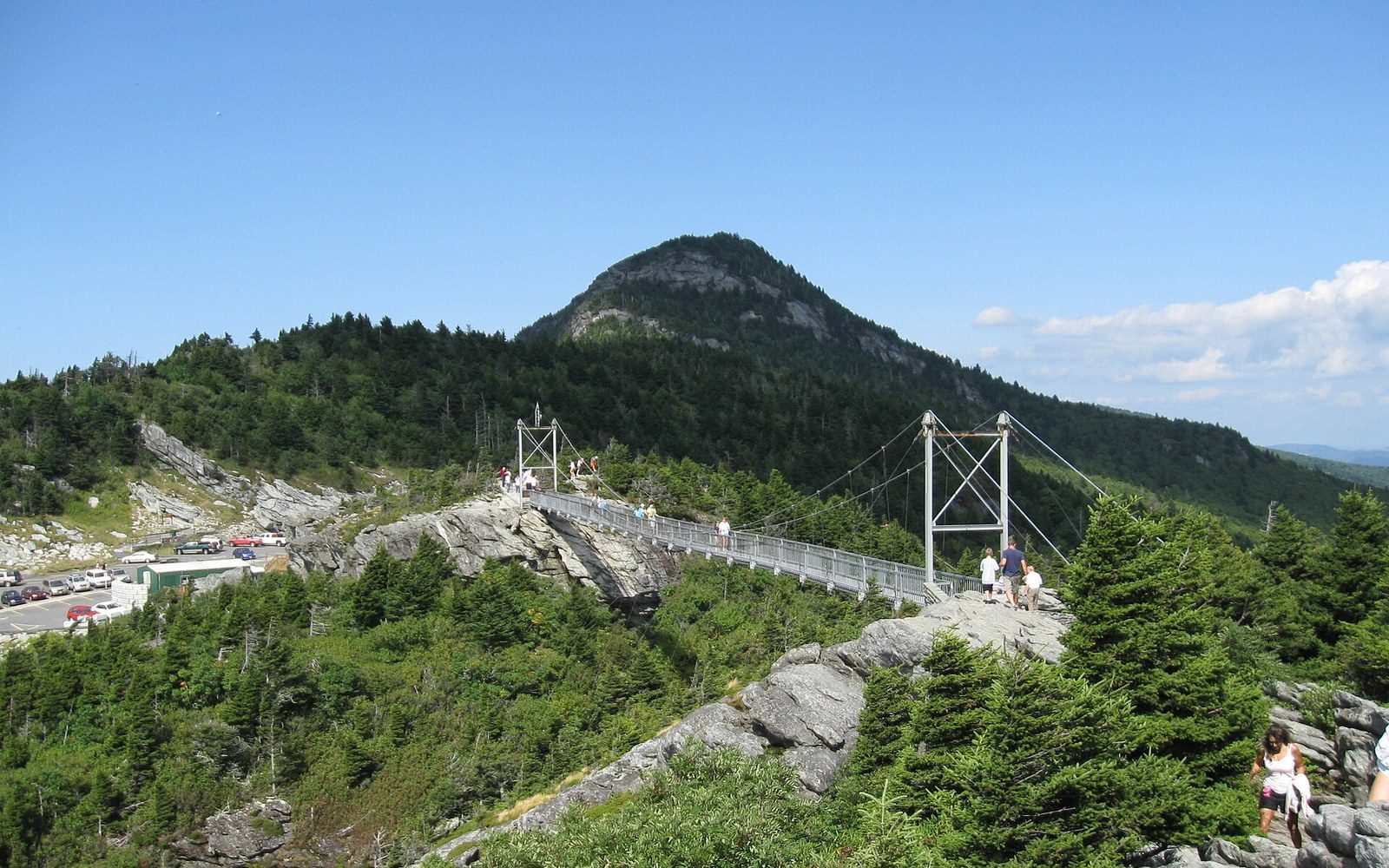
Hanging Rock, about fifteen miles to the northeast in Hanging Rock State Park, repeats the structure at a different scale. Its quartzite is part of the same general Sauratown Mountain sequence, and the rock faces there — including the feature that gives the park its name, an overhanging ledge of quartzite above a long drop — owe their existence to the same combination of rock hardness and vertical jointing. The Sauratown Mountains are sometimes called "mountains away from the mountains" because they have no topographic connection to the Blue Ridge proper; they rise straight from the Piedmont, separated from the main escarpment by the broad valley of the Yadkin River. Both Pilot and Hanging Rock are, from a structural standpoint, fragments of what was once a more continuous resistant layer, now isolated by the removal of everything softer.
Geologists working in the southern Appalachians have long understood the region as one of the world's older eroded landscapes — not ancient in the way the rocks themselves are ancient, but ancient in terms of the erosional cycle. The Appalachians began as a much higher range, the product of repeated continental collisions over hundreds of millions of years, and have been losing elevation to erosion ever since the last major orogenic pulse ended. What stands today is what resisted.
The quartzite at Pilot Mountain is Precambrian to early Paleozoic in age — older than the first fish with jaws, older than the first forests. It survived orogenies that built the mountains and erosion cycles that dismantled them. Trying to imagine the landscape as it was before the Piedmont wore away to its current level is the work of inference from rock type and elevation: you are looking at the last standing piece of a floor that once extended across this latitude at a much higher altitude. The surrounding red clay soils of the North Carolina Piedmont — that characteristic rusty color of weathered iron-bearing minerals — are in a sense the ground-up remains of everything that used to stand as tall as Pilot Mountain does now.
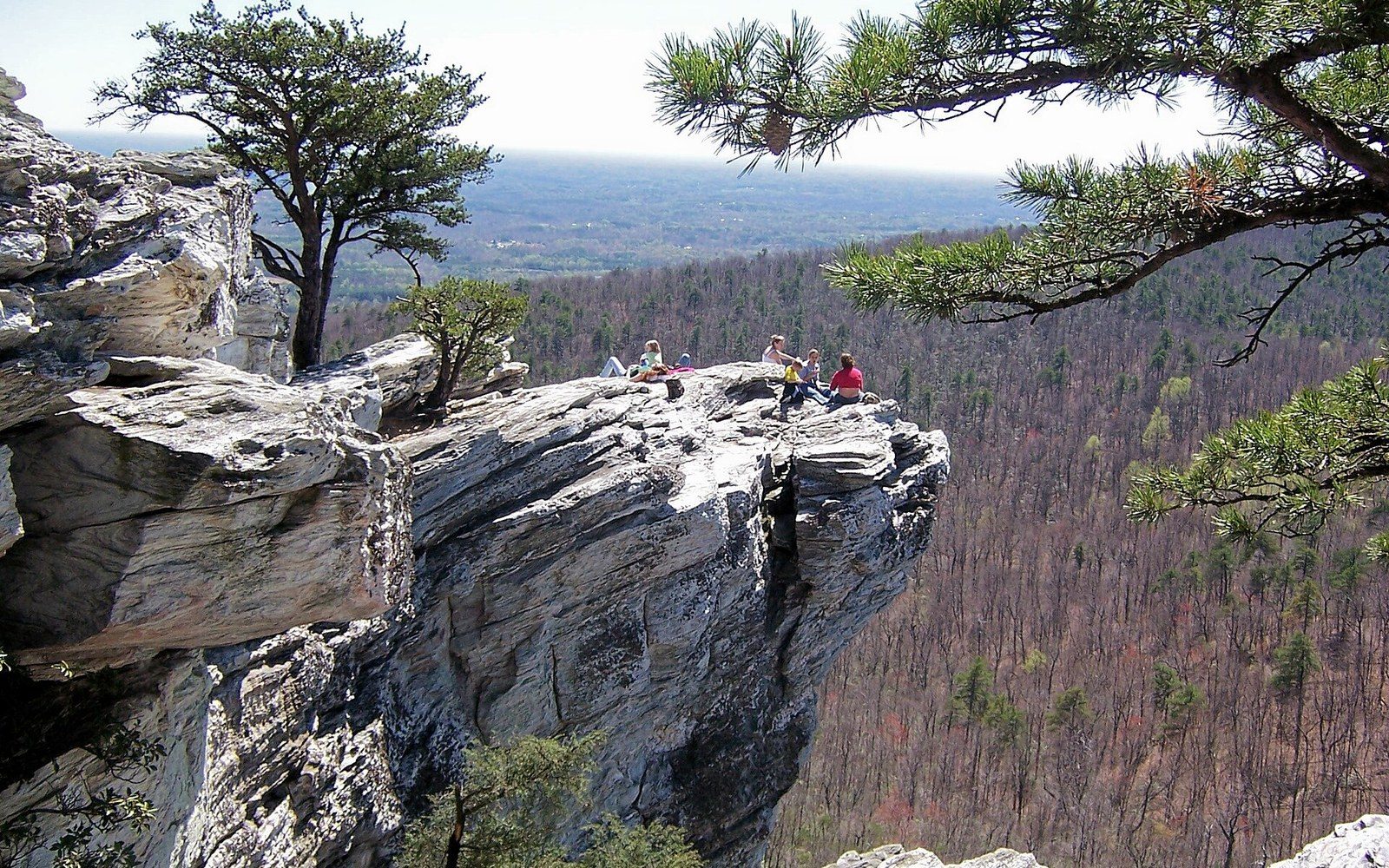
What makes monadnocks useful to anyone trying to read a landscape is precisely this quality: they are the exception that reveals the rule. If the whole Piedmont were this hard, the whole Piedmont would still stand this tall. The fact that Pilot Mountain is isolated tells you that the rock composing it is anomalous in its resistance, not representative of the region. The plain fact of its survival is a record of what the softer country around it was made of, and what the several-hundred-million-year conversation between rock and weather eventually settled.
The Civilian Conservation Corps built the infrastructure at nearby Hanging Rock in the 1930s, while Pilot Mountain became a state park only in the 1960s, but the mountain's role as a reference point runs much deeper than twentieth-century recreation. State surveyors used it; Revolutionary-era militias used it for orientation. Its appearance on the 1751 Fry-Jefferson map of Virginia and its surrounds — drawn partly from earlier surveys — reflects how fixed it was in the mental geography of anyone crossing the Piedmont before roads made landmarks less urgent.
None of that changes what the mountain actually is, which is quartzite that has been sitting in approximately this position relative to sea level for longer than most surface features on earth can credibly claim. Quartzite's resistance to weathering is not a metaphor for anything; it is a consequence of silica cementation so complete that the rock often fractures through the original quartz grains rather than around them. The mountain is not stubborn. It simply has no easy planes of failure, and weather, however patient, requires them.
When you look up at the knob from the road below and feel the instinctive pull toward drama — something pushed up, something forced through — the correction the geology offers is stranger and, finally, more interesting. The country fell. The quartzite waited. You are looking at what the land could not finish.