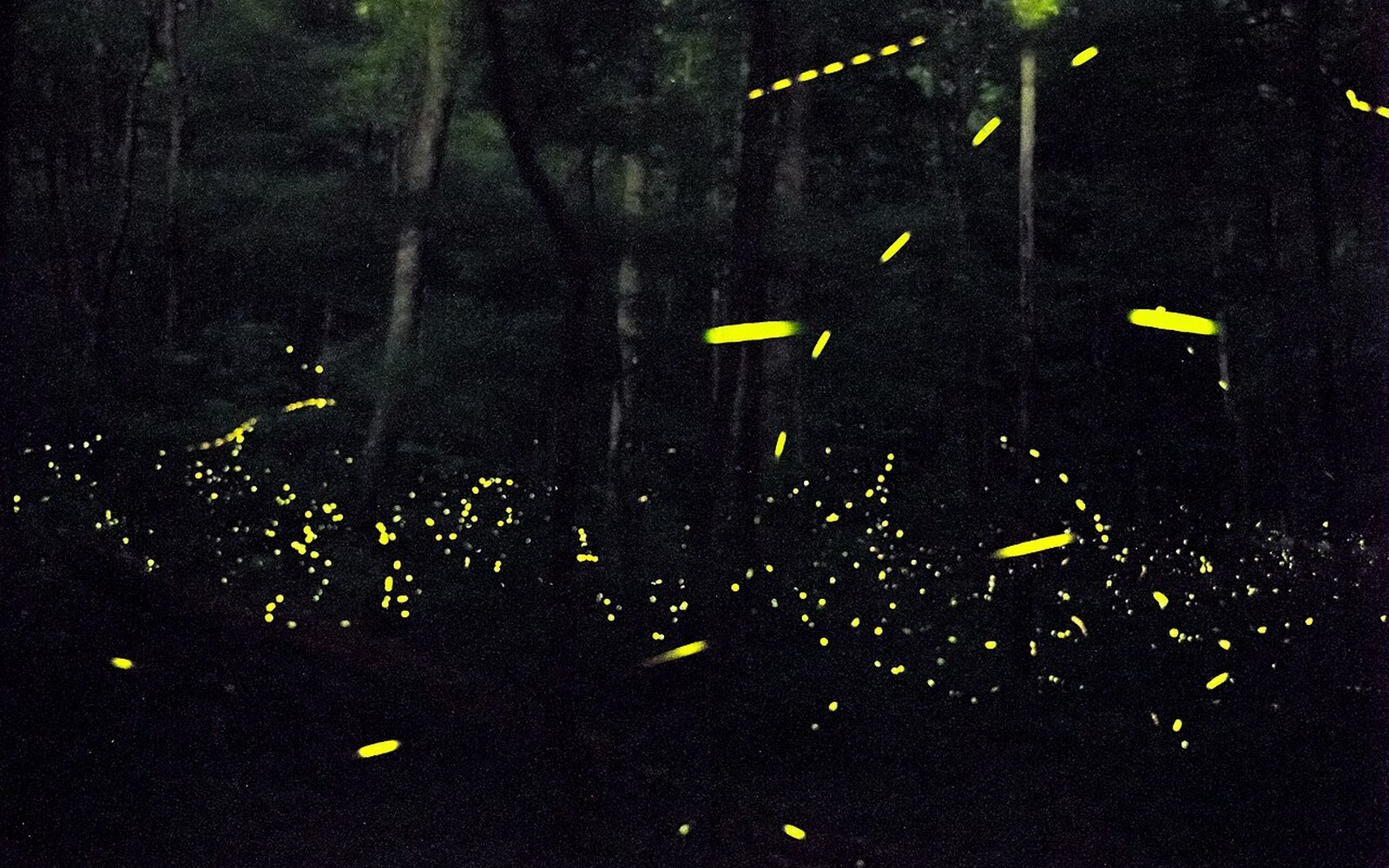
A single species among two thousand learned to synchronise, and it chose the southern Appalachians.
Most fireflies improvise. Males of different species blink at intervals that are subtly their own — rate, color, duration — and females answer from the grass. The conversation is already improbable: cold light from a chemical reaction, luciferin oxidised by luciferase in a lantern less than a millimeter wide. But Photinus carolinus does something else. The males synchronise. A hillside full of them pulses in near-unison: four to eight flashes, then a pause of eight to ten seconds of darkness, then again, the timing locked across thousands of insects at once. Where the mechanism lives — how each beetle reads the flash of a neighbor and adjusts — is still not fully resolved. Researchers at universities including the University of Tennessee have established that the synchrony builds gradually across a night, strengthening as more males enter the chorus, but a simple master-clock explanation has so far eluded the literature.

The biology underlying the flash itself is well-documented at the species level: P. carolinus is one of only a handful of synchronising firefly species in the world, and one of several synchronising species in North America. Most of the others live in Southeast Asia. The species is widely distributed through the deciduous eastern forests, but it is most reliably visible — in density high enough for the synchrony to become unmistakable — in the cool, moist hollows of the southern Appalachians, where the canopy is tall and the understory open enough to read a signal across it.
Peak activity falls in a two-week band, typically mid-to-late June at elevations between roughly 2,000 and 4,500 feet, though the window shifts with temperature and arrives earlier in warm years. Synchrony only occurs when males are actively searching for mates, which means the entire display is tied to the adult flight season — itself only a few weeks long. Larvae live underground for up to two years, feeding on small invertebrates; the adult lives perhaps three weeks, eats nothing, and flashes.
The best-documented viewing site in the Southeast is along Elkmont in Great Smoky Mountains National Park, just over the Tennessee line, where the National Park Service has run a controlled-access lottery since 2016. Demand overwhelmed the site: the shuttle parking lots were filling before dark, and the light from headlamps and camera screens was measurably disrupting the display. The ballot now draws tens of thousands of applicants for roughly a week of permitted viewing. Several sites in North Carolina — including hollows within the national forest land draining toward the Blue Ridge Escarpment — hold P. carolinus populations at comparable density, and the approach to managing them has broadly followed the Smokies model: low-impact entry, red lights only, no white light after dark.
The count methodology matters. Because the display is spread across a hillside and varies night to night with temperature, humidity and lunar phase, researchers use standardised plot counts and timed observation windows rather than raw totals. Studies published through the Ecological Society of America have examined synchrony intensity as a function of male density and forest structure, finding that dense, closed-canopy sites suppress the display while sites with a more open middle story — the kind produced by older mixed-deciduous forest with natural treefall gaps — support higher synchrony. This is one reason old-growth character matters: not just the trees, but the space they leave.
White light is the clearest suppressant. A single phone screen can halt flashing in the immediate vicinity for several minutes. Pesticide runoff affects larvae in the leaf-litter layer; the species' two-year larval stage means a bad season underground has consequences that won't register in the adult display for two years. Drought compresses the leaf litter and reduces invertebrate prey. Climate-driven shifts in the timing of spring warming appear to be moving peak emergence, in some years misaligning male flight with female readiness in the grass below. The synchrony is a signal evolved to solve a coordination problem. Anything that adds noise to the channel — light, chemical, thermal — makes the problem harder to solve.